What Equipment Should I Buy When Opening a Commercial Gym?
The equipment needed to open a gym depends on the kind of gym you're opening. Most commercial gyms need the same core: strength machines that cover every major muscle group, heavy plate-loaded leg machines, free weights with racks and benches, cable stations, cardio and proper flooring. What changes from gym to gym is the mix, the quantity, and whether you buy new, used or a combination.
This guide works through those decisions in order. For a category-by-category list of what goes on the floor, see our commercial gym equipment list. Here we focus on how to choose.
Step 1: Match the Equipment to Your Gym and Members
Before you price anything, define three things:
- Who your members are. Beginners and general-fitness members lean on guided machines. Strength athletes and powerlifters want racks, platforms, barbells and heavy plate-loaded machines.
- How the gym runs. An unstaffed 24-hour gym needs equipment members can use safely on their own. A coached studio can rely more on free weights.
- How much space you have. Floor area limits how many pieces you can fit once walkways, clearances and accessibility space are included (see Step 3).
The answers decide your split between machines and free weights, which matters more than any single brand choice.
Step 2: Cover Every Major Movement
A practical way to build a strength floor is to make sure every major movement pattern has at least one machine, then add duplicates where members will queue. A typical starting set looks like this:
| Area | Machine options |
|---|---|
| Chest | Chest press, incline press, pec fly |
| Shoulders | Shoulder press, lateral raise, rear delt (often combined with pec fly) |
| Back | Lat pulldown, seated row, plate-loaded row |
| Arms | Biceps curl, triceps extension or dip |
| Legs | Leg press, hack squat, leg extension, leg curl, calf raise |
| Hips and glutes | Hip abductor/adductor, glute kickback or hip thrust |
| Core | Abdominal crunch, back extension |
Selectorized for the main circuit
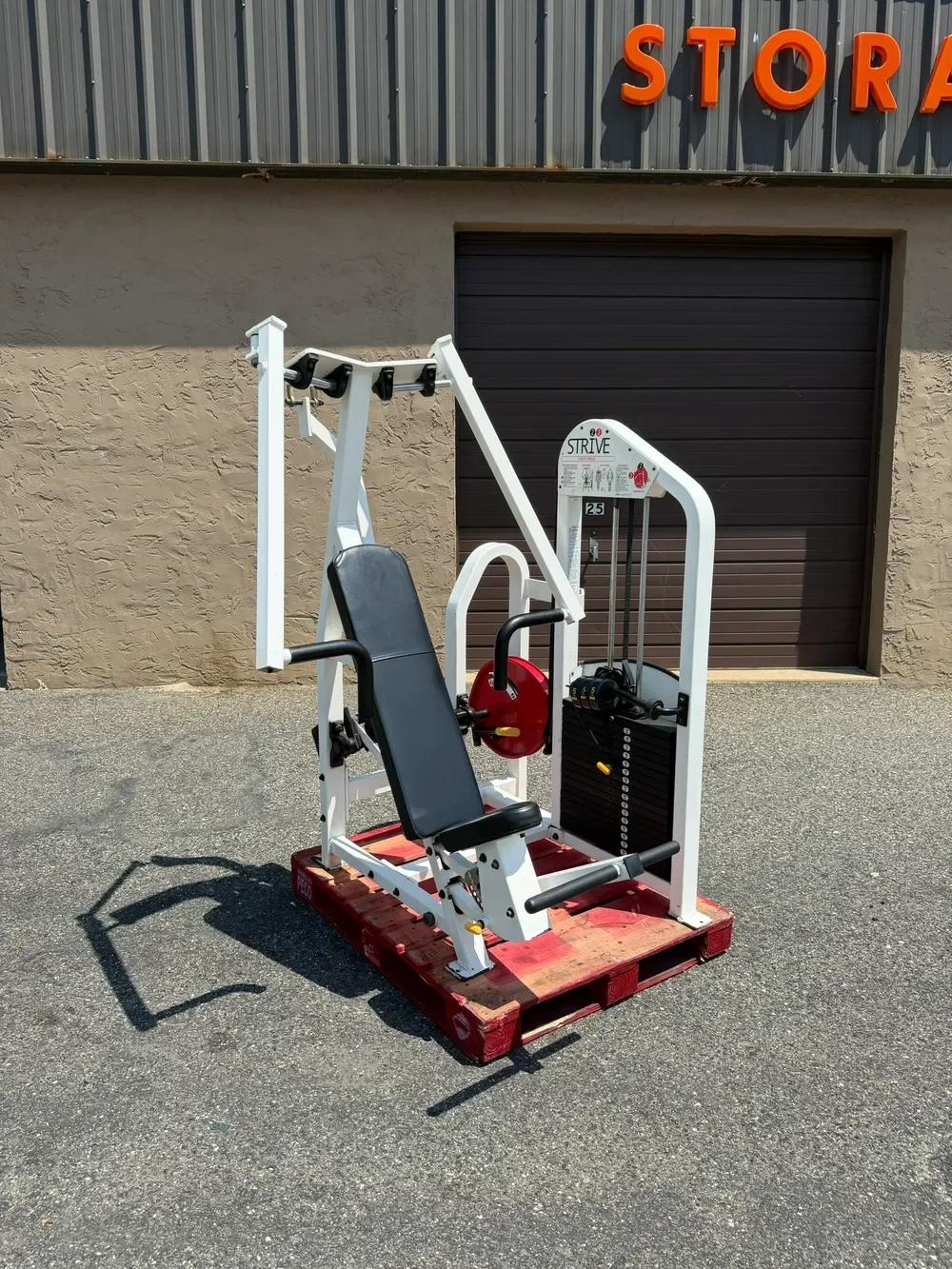
Selectorized machines have a built-in weight stack and a pin, so members change the weight in seconds. That makes them a common choice for a gym's main machine circuit. Many come as product lines with matching frames and adjustments, which makes a floor look consistent and easier for members to learn. Our Strive Selectorized Chest Press is one example of a line machine.
Plate-loaded for heavy legs and back
Plate-loaded machines take loose plates and have no stack or cables, which suits the heaviest exercises such as leg presses, hack squats and rows. The Hammer Strength Iso Leg Press is a typical commercial example. Our guide to plate-loaded vs selectorized machines explains the trade-offs.
Step 3: Plan for Accessibility From Day One
In the US, gyms open to the public fall under the 2010 ADA Standards for Accessible Design. For exercise equipment, the U.S. Access Board's guide says:
- At least one of each type of exercise machine must have clear floor space of at least 30 by 48 inches, served by an accessible route. If the space is enclosed on three sides, it must be at least 36 by 48 inches.
- Machines are different types when they work different muscle groups. A bench press machine and a biceps curl machine are different types. Two identical machine types from different manufacturers count as one type.
- Clear floor space for more than one machine may overlap.
- The machines themselves don't have to be modified to meet the ADA's controls requirements.
Plan this into your layout before ordering. Clear floor space and accessible routes take real square footage, and they're easier to design in than to retrofit. Check the details with your architect or an accessibility consultant.
Step 4: Decide New, Used or a Mix
New and used equipment differ most in price, warranty and lead time:
- New: comes with the manufacturer's warranty. For example, Life Fitness's current strength warranty for Life Fitness and Hammer Strength equipment covers the frame for 10 years; blocks, pulleys, plates and rods for 5 years; components such as cables, grips and bearings for 1 year; labor for 1 year; and upholstery for 3 months. It covers the original purchaser and isn't transferable.
- Used: usually costs less, but the original warranty doesn't pass to you. What you get depends on the seller, which may be a dealer warranty, a returns window, or nothing at all.
One approach is to buy new where heavy daily use makes a warranty most valuable, and used for simpler pieces such as plate-loaded machines, which have no cables or stacks to wear out. Our article on the cost to equip a gym breaks down what drives the total.
Step 5: Budget for More Than the Machines
- Delivery and installation: commercial machines ship by freight, and heavy pieces may need equipment and labor to move into place.
- Flooring: free-weight areas and platforms need impact-absorbing flooring.
- Plates, bars and attachments: plate-loaded machines need plates, and cable stations need handles and bars.
- Maintenance: manufacturers set inspection schedules. Cybex's VR1 owner's manual, for instance, includes weekly checks of every cable for wear and tension.
Step 6: Set Up a Maintenance Routine
Equipment that's down is equipment members can't use. Follow each manufacturer's manual, and build daily, weekly and monthly checks into staff routines. Cybex's manual says worn cables should be replaced immediately, and lists sheath tears, kinks, curling and stretching as the signs. Our gym equipment maintenance checklist gives you a ready-made schedule.
Equipment Needed to Open a Gym: Checklist
- ☐ Member profile and gym model defined
- ☐ Every major movement pattern covered by at least one machine
- ☐ Selectorized vs plate-loaded mix decided
- ☐ Free weights, racks, benches and cable stations planned
- ☐ Cardio selected for your members
- ☐ ADA clear floor space and accessible routes in the layout
- ☐ New vs used decided piece by piece, with warranty terms saved
- ☐ Delivery, flooring, plates and attachments budgeted
- ☐ Maintenance schedule written
Frequently Asked Questions
What equipment do I need to start a gym?
At minimum: machines covering chest, back, shoulders, arms, legs and core; heavy leg machines; free weights with racks and benches; cable stations; cardio; and suitable flooring. The exact mix depends on your members and space.
What equipment should every gym have?
Every gym needs a way to train each major muscle group safely. In practice, that usually means a leg press, a chest press, a lat pulldown, a row, a shoulder press, racks or a Smith machine, dumbbells and benches.
Do gym machines have to be ADA compliant?
The machines themselves don't need modifying. However, at least one of each type of exercise machine must have 30 × 48 inch clear floor space on an accessible route, according to the U.S. Access Board's guide to the 2010 ADA Standards.
Should a new gym buy used equipment?
Used equipment can cut opening costs, but manufacturer warranties generally don't transfer to second owners. Compare the seller's terms, check the condition of every piece, and budget for parts such as cables and upholstery.
Equip Your Gym
Browse our used commercial gym equipment from brands including Cybex, Hammer Strength, Life Fitness and Nautilus. If you're equipping a facility and want to check what's available across a list of machines, contact us.